
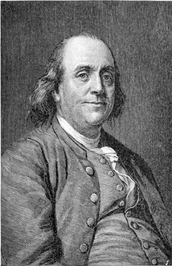
“By failing to prepare, you are preparing to fail.”
-Benjamin Franklin
Image and quote credit: http://www.goodreads.com/quotes/tag/planning
Wise words regarding planning, or the lack thereof, have been a part of the human story for generations – perhaps since our ancestors first began to communicate. Benjamin Franklin, turner of many an adroit phrase, had these words to say about preparation or planning: “By failing to prepare, you are preparing to fail.” Educators are masters of preparation. The success or failure of many a lesson can be traced back to an inadequate or ill-conceived lesson plan. We either prepare (plan) for failure or we plan for success. The same goes for technology planning in education. Technology use planning is as essential to a successful learning environment in a school or district as is a well-designed classroom lesson plan.
So what exactly is “technology use planning?” The Guidebook for Developing an Effective Instructional Technology Plan describes states that “(t)he idea of technology planning should be an attempt to be proactive instead of reactive to the situations created by technology” (1996, p. 2). Technology Use Planning is the attempt to successfully navigate the educational and technological landscapes in order to maximize the educational benefit of technology. It is, in a manner of speaking, the pathway we propose to blaze through the educational landscape and the ever-changing world of technology. Successful technology use planning is an informational process which helps all stakeholders in the educational environment understand where we are, where we believe we should be headed and how we should go about reaching our destination. The Guidebook is an excellent resource for use in understanding why technology use planning is essential for educators and how to go about actually doing the planning work and formulating a successful plan.
The impact of technology is pervasive in the United States. So extensive and important is the influence of technology that the United States Department of Education formulated a National Education Technology Plan (NETP) in 2010. This essential document for educators at all levels (state, regional, district, etc.), especially technology influencers and decision-makers, serves as a vital benchmark for technology use planning. An educator with a thorough understanding and appreciation of the core concepts of the NETP – Learning, Assessment, Teaching, Infrastructure, and Productivity – is a vital and powerful asset for achieving an effective and empowering technology use plan and turning that plan into action. As the NETP states “(t)o transform education in America, we must turn ideas into action” (p. xvi). Technology use and implementation that is properly planned – that takes into consideration all the factors involved: people, technology, financial resources – is essential to a transformed American educational system.
How do we realize a truly transformed educational system and not just overlay new technology on an old system? First, educational goals must be primary and technology use secondary. We must not fall for every technological novelty. This concept of “technology for technology’s sake” often takes place with little understanding of where technology fits in the overall educational environment and at the expense of people and the educational process. It becomes obstructive rather than constructive. A study conducted by Maltby and Mackie highlights a situation where technology is not an educational cure all. A study of the effects of a virtual learning environment (VLE) involving 1,414 undergraduate students found that VLEs do not work well for all students and can even decrease student success (2009). A well-conceived Technology Use Plan provides guidance for the appropriate place of technology in meeting educational goals.
Second, a good technology use plan has a long view perspective with a focus on short-term goals. Thus, short-term goals should all support the long-range “big picture” educational goals. Writing in 1992, eons ago in information technology time, See emphasized short term technology plans focused on applications and outcomes instead of on hardware. These holistic plans, integrated into the very fabric of the school and tied to staff professional development plans, required that technology expand on the instructional benefits of the curriculum. In this way, See sought to keep technology in its place in educational settings while squeezing as much value as possible from it for teachers, students and other stakeholders. See’s initial point drew a line in the sand regarding long term technology plans. Technology plans, according to See, are only of much use if they are for a maximum period of one year (1992). Consider this: See was writing in the days before wide availability of the Internet, laptop computers, broadband and wireless access, Windows 95 or even inexpensive cellular phone service. I agree with See. I used to work for a Tier 2 computer company and we could barely project 3 months out, let alone a year or five years. The whole Windows-based computer industry almost missed the application of tablet computing in the early 2000s. I remember when Microsoft introduced incredibly expensive tablet PCs in 2001. No one seemed to care much at the time and educational institutions balked at purchasing them. The market dwindled to a few niche markets. My how things have changed! Microsoft is back with a new tablet, the Surface, in an attempt to compete with the iPad, and, perhaps, to give the PC industry “a wake-up call” (Vance, 2012). Granted, this cycle was longer than 5 years, but the rise of tablet computing was a surprise to the computer industry. Short-term technology plans with a strong long range view allow schools of any shape or size to seize on moments of opportunity in a manner that is both nimble and proactive while avoiding the pitfalls of reactionary technology moves.
Third, a technology use plan must be grounded in reality. This applies to budgetary as well as curricular concerns. See recommends connecting the technology plan to a district’s or institution’s budget cycle (1992). Forging a connection between financial concerns and technology planning affirms both the importance of technology and its wisely planned use. Having solid financial metrics tied to technology planning also encourages administrators to provide essential support to teachers, who are the ones who will actually use the technology as part of their teaching. It is incredibly important to have proper training for teachers. This allows for the greatest opportunity of technology adoption by those who will use it the most. Without good training and teacher “buy in” of a technology plan there is great risk that the shiny new hardware will not meet its educational potential or, worse, just sit and gather dust. A final reality check comes from having a plan that is grounded in solid research. A technology use plan that includes research-backed elements such as good on-site technical support and sustained professional development stands a good chance of success (1992).
My personal experience with technology in an educational environment confirms the ideas of the material I read as part of my research on technology use planning. The school I work at, a private liberal arts university, invests a substantial amount of both human and financial resources on information technology planning. I serve on a committee that focuses on the application side of educational technology and our input is taken very seriously by our Information Technology Director when computing purchases are considered. We strive to not become enamored with a technology just because it is new and shiny. Our committee includes the following questions in any technology deliberation: “What educational value does the technology provide?” and “What does it add to what we already have?” Sometimes it seems like the decision-making process is excruciatingly slow but the decisions we make are grounded in solid research with an eye to educational outcomes, staff support and budgetary cycles. Based on what I learned in this assignment I believe the institution at which I work implements technology use planning that is supported by best practices in the field. I am better prepared to explain how and why we do what we do on the educational technology committee on which I serve.
References:
Graduate Students at Mississippi State University. (2002). Guidebook for developing an effective instructional technology plan. Retrieved from http://www.nctp.com/downloads/Guidebook35.pdf
Maltby, A., & Mackie, S. (2009). Virtual learning environments – help or hindrance for the ‘disengaged’ student? ALT-J, Research in Learning Technology 17(1), 49-62. Retrieved from http://www.eric.ed.gov/PDFS/EJ831099.pdf
See, J. (1992). Developing effective technology plans. The Computing Teacher, 19(8). Retrieved from http://www.nctp.com/html/john_see.cfm
U.S. Department of Education Office of Educational Technology. (2010). National Education Technology Plan. Alexandria, VA: Education Publications Center. Retrieved from http://www.ed.gov/sites/default/files/netp2010.pdf
Vance, A. (2012, July 9). Why Microsoft’s Surface tablet shames the PC industry. Bloomberg Businessweek: Technology. Retrieved from http://www.businessweek.com/articles/2012-06-19/why-microsofts-surface-tablet-should-shame-the-pc-industry
This post addresses Standard 3.4 of the AECT: Policies and Regulations, which reads: “Policies and regulations are the rules and actions of society (or it surrogates) that affect the diffusion and use of Instructional Technology.” The completion of this activity demonstrates that I have studied and been influenced by policies devised by the U.S. Department of Education as I consider how to construct an effective Technology Use Plan.


 Lance McGrath: EDTECH Learning Log
Lance,
I really enjoyed your commentary on technology use planning. The part of your report that rang the truest for me was the idea of a “transformed” educational system. I listen to a lot of teachers and they all have ideas on how our educational system needs to change (or stay the same). It is that diversity of opinion that always concerns me when “technology” and “education” are mentioned in the same breath. Our public education system has remained virtually unchanged since its inception – how many other things do you know of that can claim the same (US Post Office)? We all get excited about the latest and greatest toys but which “toys” get our students to where they need to be? Maybe instead of teaching our subject matter though computer programs we ought to have our students programming our subject matter? I use Examview in my math classes and am toying with the idea of having each student through the year “program” their own problem banks that address the concepts we study. In order to do this they would need to have a very detailed understanding of the concepts, relationships, and number-sense. It would also require the kind of problem solving and critical thinking skills that seem to be the current focus.
I have always thought that our educational system should be focused on “what can we do to make each and every one of our students a contributing member of society – economically, socially, civically, and morally?” Lofty I know, but isn’t that the point? Anyway – great job!
Well done Lance, your writings always entertain and amaze me! I agree the use of technology has permeated our society, and aren’t we blessed to be in a country that takes the steps to stay ahead of the rest of the world? I was just reading a document on “Solar Roadways” it quickly brought to mind how our world is changing and how if we don’t stay ahead of the technology curve with our students how will they ever compete in the job market. But then quotes like yours “We must not fall for every technological novelty. This concept of “technology for technology’s sake” ” makes you realize that planning is more than just very important. It is an imperative. If you don’t plan you could fall into the “technology’s sake” argument!
Lance, I loved your piece from start to finish. Here’s why:
The image of and the quote by Benjamin Franklin are perfectly suited to your position; I really appreciated how you used the quote as a structural guide fro your position / philosophy with regards to technology use plans.
(Yup, you impressed the English teacher in me!)
Furthermore, I like how you confidently present what a technology plan must do if it is to be successful (eg. meet the needs of the users it impacts). Of course, your thorough research and fully developed examples also enhance your already effective argument / position.
I even liked how you “highlighted” your significant points by bolding them, Fine attention to detail, like this, pulls your reader further into your discussion because he or she knows you mean what you say, and say what you mean! You gently but firmly bring them face to face with THE “light”.
Your personal examples also hit home by making the whole issue a lot more “human” — for lack of a better word. What you reinforce here is that technology use plans must be designed for real human beings by real human begins! The plan cannot be faked or haplessly thrown together; if a plan is to work, it must consider the actual needs of the people it affects.
Excellent work!
Nona