
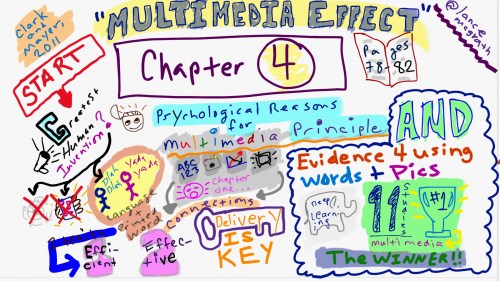
Click HERE for a larger PNG version of the sketchnote pictured above
This week in EDTECH 513, Multimedia, we were tasked with creating a sketchnote of a portion of our course text, e-Learning and the science of instruction, by Clark and Mayer. Sketchnoting, for those not in the know, is basically note-taking with doodles. It is enhanced note-taking that leverages the multimedia principle, which posits that words and graphics are more effective in communicating a message rather than plain text. Some sketchnotes are incredibly detailed works of comic-style art. These are often hand drawn in gorgeous notebooks with rich paper and an arsenal of writing instruments. Others are computer-generated and take the form of infographics. These sketchnotes might utilize clip-art and computer-generated fonts. Since I am in an educational technology class, I decided to stretch myself outside of my comfort zone (it takes me a while to draw) and draw my sketchnote freehand on my touchscreen Dell Inspiron 15 7000. The process went remarkably well. More about that later.
What did I sketchnote about? I chose to sketchnote about two concepts discussed by Clark and Mayer in Chapter 4 of their text. The first was the psychological reasons for the multimedia principle and the second was the evidence for using words and pictures to enhance learning. The sketchnote provides a guide to the sections using both text and images. The first thing to note, by beginning at the big red START, is that the authors observed that language is quite possibly the greatest human invention, followed by written language. It is effective and efficient. The addition of graphics makes communication multimedia in nature and increases the connections to the message and the content. Delivery is key. Format is not as important. There is evidence that using multimedia leads to deeper learning. This is backed up by the findings of eleven research studies. The concept of the multimedia effect, that words and pictures are better at helping humans learn than just words, holds overarches the entire section.
How did the whole process go? As I mentioned above, it went well. I decided to take the plunge and draw my entire sketchnote freehand on my computer. I have never done this before. I have some issues with fine motor control and much prefer to use clip-art for images and typed letters for textual communication, if only in the interest of legibility and time. I will probably use an infographic application to generate other sketchnotes in the future. I can concentrate more on delivering content instead of having to redraw images that do not turn out right. Alternately, I might create sketchnotes using pen and paper and then digitize the final result. The task was enjoyable, but time-consuming for me given my novice status in drawing on a touchscreen. I rendered the sketchnote on a Dell Inspiron 15 7000 in Plumbago, a Microsoft application. I used a Dimples Excel stylus with the silicone end, not the larger fabric stylus tip. The screen was responsive to the stylus and the screen did not pick up much palm activity and register it as input. The image was drawn without zooming in for detail work. I need to spend more time exploring the Plumbago app and the full suite of settings and features. The process of sketchnoting my notes really helped me to forge strong connections to the material. My brain had to work both the verbal and spatial areas in order to plan out and create the sketchnote artifact.
There are many examples of sketchnoting on the Internet. I hope that seeing what I have done encourages you to give sketchnoting a try, either for yourself or with your students.
By completing this activity, I demonstrated competence of AECT standards 1.2. Message Design, 1.3 Instructional Strategies, and 2.3 Computer-Based Technologies. The activity meets the requirements of AECT 1.2 because I planned and designed the creation of a message in the form of a sketchnote, which leverages the multimedia effect to deliver a message in a manner that benefits the learner. The activity also supports AECT 1.3 because the creation of the sketchnote is a purposeful instructional strategy that will contribute to student learning. Finally, the activity supports AECT 2.3 because the artifact, a digital sketchnote, was generated and delivered using computer-based technology exclusively.
Best,
Lance
Reference:


 Lance McGrath: EDTECH Learning Log